Introducing Safenet Aegis: Enforceable transaction security for Safes

Safe
Today Safenet Aegis is launched into a world with new threats to self-custody. AI is supercharging attacks through poisoned addresses, malicious apps and compromised front ends. These attack vectors reveal a pattern: the signature is valid, but the transaction does something other than what the user expects. We need to level up defences. Current paradigms for defence are often mere UI warnings, and they are no longer enough. Safenet fundamentally changes that.
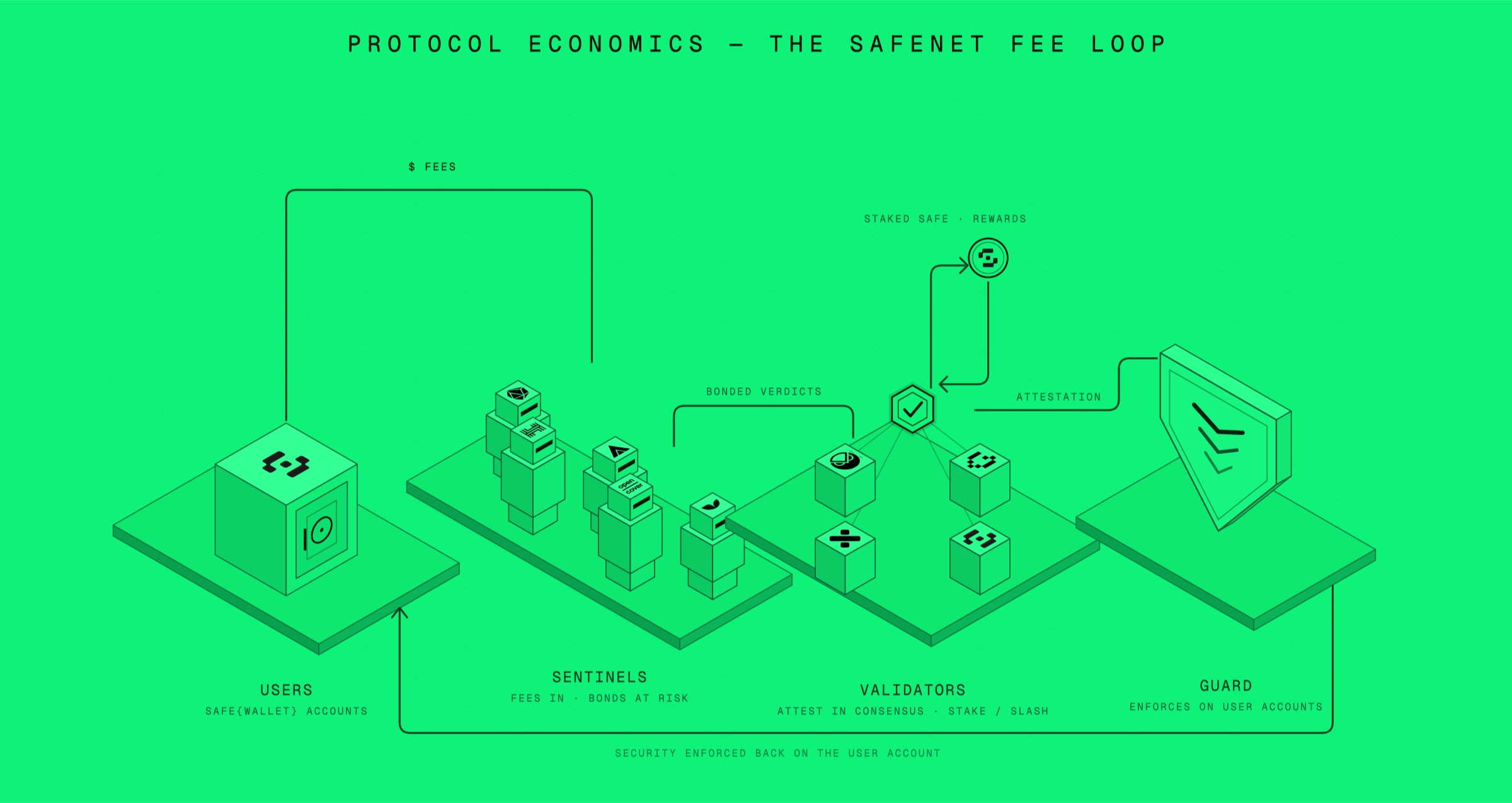
Safenet is a decentralized network with two distinct roles: independent transaction checkers (Sentinels) assess transactions, while Validators verify the checks and attest the result onchain. This makes the result enforceable on the user's account, even if the user mistakenly signs a malicious transaction.
Following Safenet Beta, Safenet Aegis is the first production-ready protocol version with onchain fees for network participants. Safenet is governed by Safe{DAO}.
Safenet Principles: Making security decentralized, accountable and enforceable onchain
Safenet is designed to reimagine the security economy. It innovates in a few areas of the security value chain, based on the following principles.
Open markets are a better way to solve threat coverage: Safenet opens up security demand to a market of providers. Users get the intelligence of several proprietary threat detection models from some leading security players all passing verdicts independently on their transactions. Over time, this fundamentally improves threat coverage.
Security assessments need accountability: Security providers pass their verdicts like they do today, but there is a difference. In Safenet, they submit their evaluation along with a bond. They have skin in the game: incorrect verdicts can trigger slashing under the protocol's rules. This creates accountability for the quality of their assessments.
Onchain attestations are more reliable than UI warnings: Our industry has learned time and again that UIs are not a reliable surface for security assessments involving critical operations and meaningful value. Attesting security results onchain makes them verifiable and enables trustless enforcement.
Circuit breakers can protect users, even from themselves: Self-custody has no undo button, but it can certainly have circuit breakers. With smart accounts, onchain guards can enforce limits on the account and act as circuit breakers when there is a signal of a threat. The same principle could also protect accounts operated by autonomous agents, where security enforcement is essential.
Safenet Aegis: How it works
The Charter: an objective, upgradable rulebook
Every check is done against the same rulebook: the Safenet Charter. The Charter sets out the principles and governance framework underpinning transaction checks in Safenet, and defines what "secure" means under the Safenet protocol rules. The Charter gives all participants a common standard for judging transactions. Some rules for determining whether a transaction is secure are deterministic, like flagging unauthorized changes to a Safe's owners or modules. Others weigh evidence, but only evidence anyone can verify: onchain history, signed intent, public security reports. Assessments must be grounded in verifiable evidence, rather than unsupported private claims.
If a transaction check is disputed, the Safenet Security Council will determine whether the transaction check complied with the Charter, in accordance with the arbitration rules of the Charter.
Attackers keep changing, so the charter can too and Safe{DAO} can amend it. The first version of the Charter was approved by Safe{DAO} and each new version is published onchain, and every transaction is judged by the version in force when it was proposed.
Safenet focuses on transaction risks that can be determined from the proposed transaction and relevant Safe state. Economic attacks are outside the current Safenet Aegis scope. To understand the transaction assessment criteria of Safenet please check the rules in the Charter.
Combined threat intelligence of many - Sentinels
Sentinels are the checkers. When a transaction is proposed, independent Sentinels, each run by a different operator, check it against the Charter: recipient and target manipulation, changes to a Safe's owners or threshold, dangerous approvals, delegatecall integrity, and known-malicious targets. Their verdicts combine into one result: secure, insecure, or a split that goes to arbitration. Sentinels hold each other in check. No single Sentinel can pass a bad transaction or block a good one.
Safenet Aegis release launches with OpenCover, IntentGuard, Candide and BlockSec as Sentinels on the network, each bringing their own threat intelligence to check user transactions against the charter.
Attested onchain - Validators
Validators turn a secure result into a single onchain attestation, signed collectively with a threshold scheme (FROST) so no single Validator holds the key and a few faulty ones can't break it. Validators stake SAFE and earn rewards depending on their performance and uptime. SAFE holders who don't run a node can delegate to a Validator and earn a share of the rewards for securing the network. Safenet Aegis launches with the following Validators: Gnosis, Core Contributors, Greenfield, and Safe Labs. Only Safe{DAO} can change the validator set through governance and a truly permissionless validator set is further on the roadmap.
Enforced by a circuit breaker on your Safe account - the Guard
The optional Safenet Guard makes the verdict enforced: a transaction executes only if it carries a valid attestation for that exact transaction. It's opt-in, with a delayed escape hatch so you always keep control of your account. You can also trigger and read Safenet's checks without enabling the Guard.
Integrated in multisigs first and coming to smart accounts everywhere
In Beta, Safenet ran beside the wallet. In Aegis, the checks are built into the Safe{Wallet} transaction flow. That ships in Q4 2026 on Ethereum mainnet, Arbitrum, and Gnosis Chain, starting with visible checks and adding optional Guard enforcement. Security you have to go looking for is security most people never turn on; here it's just there when you sign. Expansion to other account types, including EIP-7702-enabled accounts, and support for frame transactions are being considered for a future version.
The economics for security: Safe{DAO} owned fees model
A decentralized security network only stays decentralized if the people running it can be paid to do so. Safenet introduces two participant classes, and two distinct economic engines behind them.
Sentinels are paid in stablecoins. Every check carries a fixed fee - 0.40 USDC at launch. Today that fee goes entirely to the Sentinels who did the checking - Safe{DAO}'s protocol share is set to 0%, with a fee switch the DAO can turn on later once volume can support it. Each Sentinel also posts a bond for every check (800 USDC at launch). Slashing is phased in: during the first three months, only the 0.40 USDC check fee is at risk, rather than the full bond. Paying for a security service in the currency of that service keeps the incentive clean: Sentinels earn by applying their threat intelligence models to users' transactions, with accountability governed by the protocol's slashing rules.
Validators, and the Delegators who back them, participate through SAFE. Staking SAFE is what secures the attestation layer and earns validator rewards based on participation rate, and delegation lets any holder take part without operating a node. Each Validator stakes a minimum of 3.5M SAFE, and Safe{DAO} governs admission to the Validator set.
Safe{DAO} owns the fee model
Safenet is immutable and non-upgradable. Updates of the following parameters have to follow the Safe{DAO} governance process. The check fee, the potential DAO's share of it and where that share goes, the bond and slashing amounts, and who sits in the Sentinel and Validator sets - all of it is decided by SAFE holders. And it is enforced onchain: a Safe{DAO}-controlled Safe on Gnosis Chain, wired into Snapshot, so a passed vote enacts the change directly rather than asking a team to honor it. Safenet's core contracts are non-upgradeable. So when the network eventually turns on the fee switch and begins taking a protocol share, it is Safe{DAO} that decides it - which is what makes these onchain protocol fees Safe{DAO}-aligned.
SEP-56 was unanimously accepted to bootstrap the Safenet economy. SAFE staking rewards for Validators and milestone-based grants for the first Sentinels are planned to support the network as it proves out a real revenue model, with a target of at least $30k in monthly recurring revenue by the end of 2027. Safenet’s eventual ambition is solving security for the large ecosystem of Safe and a $60B TVL with transaction volume processed at over $1 Trillion.
Safenet Aegis is live: A key milestone
Safenet Aegis has gone through rigorous audits and formal verification for key components like the Safenet Guard and staking contracts. Aegis uses the same staking contract as Beta, so existing stake carries over seamlessly with no user action required. It is live now on Arbitrum, Gnosis Chain and Ethereum mainnet - with the first set of chosen Sentinels and Validators. The opening up of sentinels and validators and getting broader network participation over time, is on the roadmap for Safenet. With the Safe{Wallet} integration targeted shortly within Q4 2026, Safenet Aegis is set to bring built-in checks to Safe{Wallet} transactions and improve the threat posture for multisig users, with enforcement available to accounts that opt into the Guard.
Read Formal Verification and Audit Status
Read Documentation
Explore Roadmap
Get involved
Safenet Aegis is built in the open, and there are 2 ways to take part:
Build with Safenet. Wallet teams, Validators and Sentinels: get in touch. Or follow the build in the Safenet Telegram group.
Explore Safenet. See how it all fits together at safenet.xyz.
Share this